First Weeks of Class
This semester has been nothing short of incredible so far. Coming off of a great experience at SEEK26, I was able to hit the ground running when I moved back to the seminary. Prayer is going great. The horarium of the Liturgy of the Hours has been easy to maintain. I have mostly been able to go to bed on time.
The part that I was not expecting to be great is my academic formation this semester. My courses have been nothing short of mind-blowing so far. I have found myself taking pictures of things that I am reading and sending them to my friends outside of the seminary. I can't say that I have done much of that in the past.
The two particular classes that have been most impactful have been liturgical + sacramental theology and Christian anthropology. Both of the professors take an extremely Christocentric approach to their topics, so they naturally converge in many areas. In liturgical theology, we have been discussing the act of liturgy itself being a work of God on behalf of man versus a work of man on behalf of God.
This can seem like a small distinction, but it can wreak major havoc if the wrong version is promoted to its fullness.
When explaining the action of the liturgy, Pope Pius XII teaches:
Now the sacrifice of the New Law signifies that supreme worship by which the principal Offerer himself, who is Christ, and, in union with Him and through Him, all the members of the Mystical Body pay God the honor and reverence that are due to Him. (Mediator Dei #93)
If we do not let Christ be the one who is initiating the work of sacrificial worship, then what are we actually offering to God?
In many cases where the liturgy is celebrated poorly, one may read that quote from Pope Pius XII and simply be confused. If one goes to Mass primarily to receive, whether it be from the Word of God, the homily, or the Eucharist, their "worship" is misguided. This is no longer the work of Christ because the work of Christ leads to one giving himself entirely to the Father.
Yes, one of the purposes of the work of God is for man to receive His grace, but this grace should lead one to live a life of total gift for both God and neighbor. There is an irony to the Protestant idea of the 'altar call' because it actually demands that one give their life to God in sacrifice. This is what every Mass is supposed to entail.
Likewise, a community's expression of worship can accidentally take on a selfish characteristic that leads to the community glorifying itself rather than God. When a parish is proud of their unique expression of music, liturgical dance, or other innovation in the Mass, one must ask, "Why was there a need for innovation?" Unless there are legitimate pastoral circumstances, one must allow themselves to be formed by the liturgy, not let the liturgy be formed by their own opinions. When one tinkers with the liturgy themselves, it then becomes a work of man rather than a work of God.
I can already hear some of you thinking, "But Connor, don't you prefer Gregorian chant and Latin? Aren't those just your personal preferences?"
Yes, they are my preferences now, but they only became my preferences because I allowed myself to be formed by the tradition of the Roman Rite's liturgy. Gregorian chant can be very difficult and clunky to sing at times, but I still trust that we ought to give it pride of place. Latin is difficult to pronounce at times, let alone understand, yet the Church says it is very beneficial to retain it.
The Church, guided by the Holy Spirit, has great wisdom in what she gives us. It is not my duty to try to scientifically understand why something is beneficial for me to embrace. Does a newborn question the food that its mother provides for nourishment? No. Likewise, when the Church asks me to participate in a certain way, it is not my duty to throw a temper tantrum or rebel against it.
I know that this issue is much more nuanced than that, but hopefully I will have more to say as the semester goes on.
The primary reason that I wanted to write today was actually what we discussed in my anthropology course. I was not expecting to connect a course about humanity to active participation in the Mass, but it happened today!
In 1990, Cardinal Ratzinger published an English translation of a text that he wrote in the 1970s regarding what a 'person' or 'persona' is in theology. He says,
For scripture has clearly brought out precisely this phenomenon of pure relativity as the nature of the person. The clearest case is Johannine theology. In Johannine theology we find, for example, the formula, "The Son cannot do anything of himself" (5:19). However, the same Christ who says this says, "I and the Father are one" (10:30). This means, precisely because he has nothing of himself alone, because he does not place himself as a delimited substance next to the Father, but exists in total relativity toward him, and constitutes nothing but relativity toward him...
This structure is in turn transferred - and here we have the transition to anthropology- to the disciples when Christ says, "Without me you can do nothing" (15:5)...
It is thus part of the existence even of the disciples that man does not posit the reservation of what is merely and properly his own, does not strive to form the substance of the closed self, but enters into pure relativity toward the other and toward God. It is in this way that he truly comes to himself and into the fullness of his own, because he enters into unity with the one to whom he is related.
This is a lot to chew on, but I will attempt to unpack it.
When I read this, I am hit with themes of selflessness, self-gift, sacrifice, and ultimate charity for others. A man's identity is not in anything of his own. Our modern society has formed us to think that individual persons are actually individual substances who are born into a blank slate of sorts. They have God-given rights, and they can "choose what is best for them" as if they can create their own meaning.
Ratzinger says that our modern society has it completely wrong. From the beginning, man was created in relationship with God. What the heck is going on in the Garden of Eden if God isn't a part of Adam's life? God created Adam and Eve to be in relationship with Himself, and all was well with the world (besides the rebellion of Satan and his servants).
The moment that Adam and Eve embraced the idea of themselves as individual substances is the moment when sin entered the world. Adam rejected his relationship with God, and hence he did not protect Eve from the temptation of the serpent. Eve rejected her relationship with God, and hence she not only trusted the serpent, but she dragged Adam into the sin as well.
It is the new Adam and Eve, Jesus Christ and Mary, who fully embraced the idea of man identifying himself to be in relationship with others and primarily with God. They gave entirely of themselves to another and ultimately to God. This is why Ratzinger uses Christ as the model for humanity, and Mary is also a great model since she was also free from original sin.
This is integral to the Mass, and I think the fathers of Vatican II said it best. My favorite line from Vatican II comes from Sacrosanctum Concilium #48 which says:
The Church, therefore, earnestly desires that Christ's faithful, when present at this mystery of faith, should not be there as strangers or silent spectators; on the contrary, through a good understanding of the rites and prayers they should take part in the sacred action conscious of what they are doing, with devotion and full collaboration. They should be instructed by God's word and be nourished at the table of the Lord's body; they should give thanks to God; by offering the Immaculate Victim, not only through the hands of the priest, but also with him, they should learn also to offer themselves; through Christ the Mediator, they should be drawn day by day into ever more perfect union with God and with each other, so that finally God may be all in all.
Is this not the exact idea that Cardinal Ratzinger was trying to communicate? Humans are fundamentally oriented towards God, so they achieve their flourishing when they orient their entire lives in His direction.
True life is found when we lay it down for another. This is precisely what Christ dedicated his life towards. He didn't come merely to be a servant to humanity's wishes. If He simply wanted to serve our own desires, then we would effectively have a divine form of Santa Claus as our God.
If we want to be human as God designed us, then we ought to deny ourselves, pick up our Crosses, and follow the Lord Jesus. If we don't do this, then we will always be empty and never find true flourishing.
There is another element of Christian worship that I haven't commented on much in the past, and that is the communal element of worship. I know that community can stir up a lot of feelings in regard to Christian worship. I think we can all imagine a Christian community that thinks that the purpose of Mass is a human-centered, community gathering. If you have read along this far, then you can understand why this is misguided.
At the same time, there is a temptation to think that Mass is purely between myself and God. I have heard traditional priests say language like "the laity come here to pray their Mass." How does one possess their own private Mass? Even though a Mass may be said in private, it is still a public, liturgical action.
Does a priest re-scribe every prayer of the Mass from the first person plural to the first person singular? Of course not.
Even the presence of the angels and saints at every liturgy is enough to make a liturgy public, not private.
Community is an essential element to the Holy Sacrifice of the Mass. Pope Pius XII says:
And as the Divine Redeemer, when dying on the Cross, offered Himself to the Eternal Father as Head of the whole human race, so "in this clean oblation" He offers to the heavenly Father not only Himself as Head of the Church, but in Himself His mystical members also, since He holds them all, even those who are weak and ailing, in His most loving Heart." (Mystici Corporis #82)
[Sacred liturgy] is, in short, the worship rendered by the Mystical Body of Christ in the entirety of its Head and members (Mediator Dei #20)
When we are baptized, we enter into the mystical body of Christ. We truly become a part of Christ himself! This is why baptism makes us prophet, king, and priest. All members of the body of Christ are destined to participate in the worship of God.
Even though Christ's sacrifice is perfect and immaculate, we have a unique duty to offer ourselves in sacrifice. One of my favorite Dominican priests, Fr. Paul Keller O.P., explains this well when he writes:
Just as Paul rejoiced to join his sufferings to Christ's afflictions in order to complete what was missing (namely, Paul's sufferings), so, too, we may see the joining of our worship to Christ to complete Christ's sacrifice of worship to the Father. (The Importance of a Correct Definition of Liturgy for Divine Worship, Conclusion)
We need to worship in community precisely because the offering made to God is communal. This nature is reflected in traditional, western Church architecture.
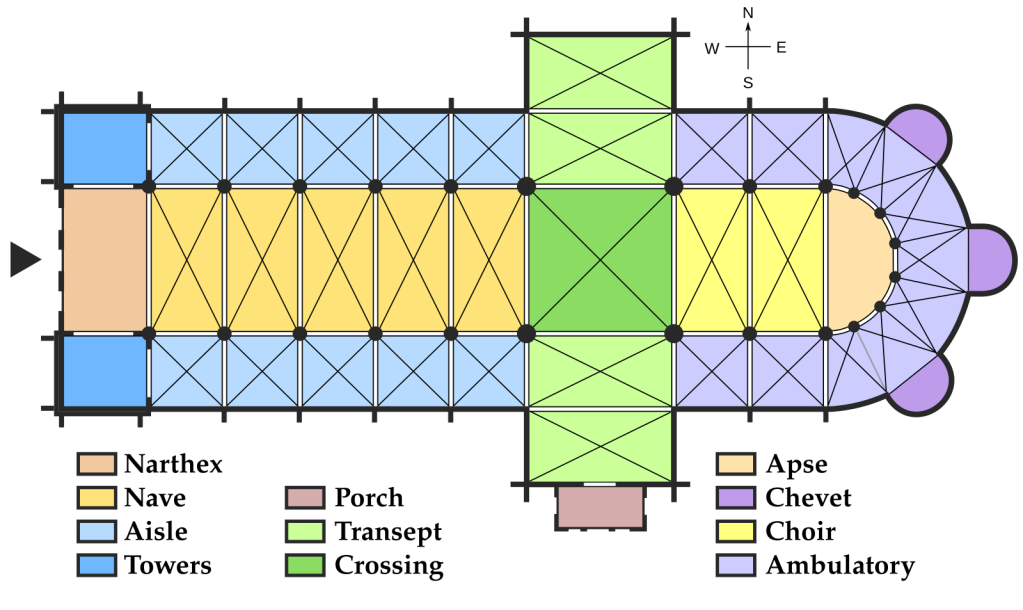
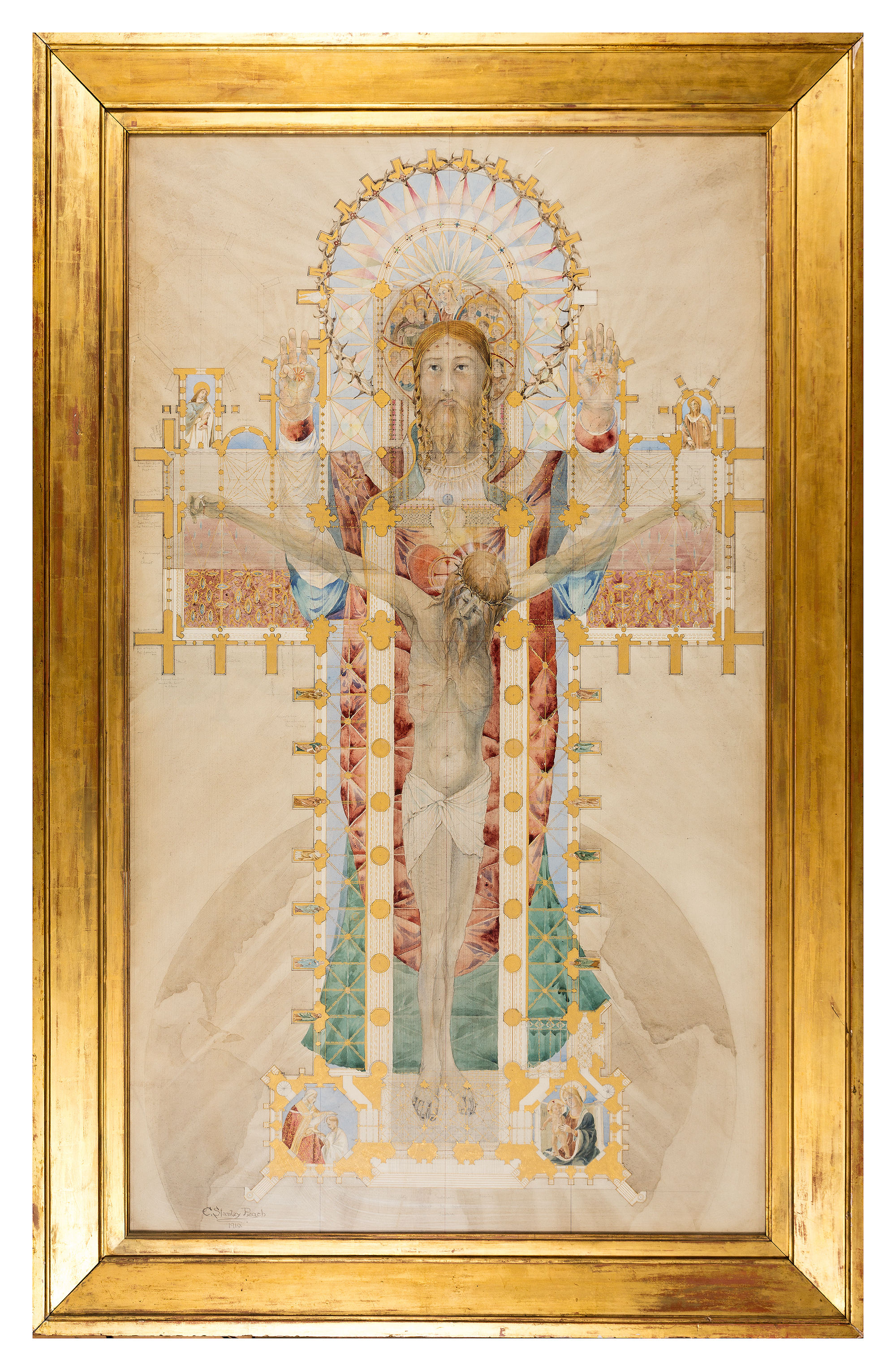
A traditional gothic church is shaped like the Cross on purpose. The head (Christ the High Priest) is found at the head of the Church in the sanctuary. Just below the head is where the monastic choir traditionally sat. The choir can be thought of as the vocal cords of the mystical body (but all are encouraged to sing). The main nave and side areas are where the other members of the mystical body of Christ sit.
While we can't all be the head, we all are united by the head. The altar is located where the head is because it is Christ himself who unifies us together.
The next time you find yourself preparing for Mass, reflect on at least one of the ideas in this post. I hope to continue sharing the treasures of the faith that have fundamentally changed how I view and participate in the life of God.
If something in this post struck you, please let me know! I primarily write these blog posts for my own benefit, but I am always encouraged when I hear how others are impacted as well!